

Laser Hair Removal for Different Skin Types: A Complete Guide
Laser hair removal is one of the most popular aesthetic treatments available today, but not every laser works the same way on every skin type. Your skin tone, hair color, and melanin levels all play a role in determining which laser technology will deliver the safest, most effective results. Understanding the relationship between your unique complexion and laser wavelength is the key to achieving smooth, lasting hair reduction without unwanted side effects. In this guide, we break down how laser hair removal works across the full spectrum of skin types and what to expect at each stage of treatment.
How Laser Hair Removal Works
Laser hair removal works by targeting the melanin in the hair follicle. The laser emits concentrated light that is absorbed by the pigment in the hair, converting it to heat, which damages the follicle and inhibits future growth. This process is known as selective photothermolysis, the principle of selectively heating a target chromophore while minimizing damage to surrounding tissue.
Melanin is a natural pigment that gives color to both skin and hair. Because the laser relies on melanin as its target, the contrast between hair color and skin tone directly affects treatment outcomes. Dark hair on light skin has historically been the easiest combination to treat, but modern technology has expanded access significantly.
Understanding the Fitzpatrick Scale
The Fitzpatrick scale is a dermatological classification system that categorizes skin into six types based on how it reacts to ultraviolet light exposure. It was developed by dermatologist Thomas Fitzpatrick in 1975 and remains the standard tool used by aesthetic professionals worldwide to guide laser settings.
| Fitzpatrick Type | Skin Tone | Sun Reaction | Recommended Laser |
|---|---|---|---|
| Type I | Very fair | Always burns, never tans | Alexandrite, Diode |
| Type II | Fair | Burns easily, tans minimally | Alexandrite, Diode |
| Type III | Medium | Sometimes burns, tans gradually | Diode, Alexandrite |
| Type IV | Olive | Rarely burns, tans easily | Diode, Nd:YAG |
| Type V | Brown | Very rarely burns | Nd:YAG |
| Type VI | Dark brown/black | Never burns | Nd:YAG |
When you visit Contour Body Aesthetics for an initial consultation, your specialist will assess your Fitzpatrick type to determine the ideal laser wavelength and energy settings for your treatment plan.
Laser Types and Their Ideal Skin Tones
Different lasers operate at different wavelengths, each suited to specific skin and hair combinations.
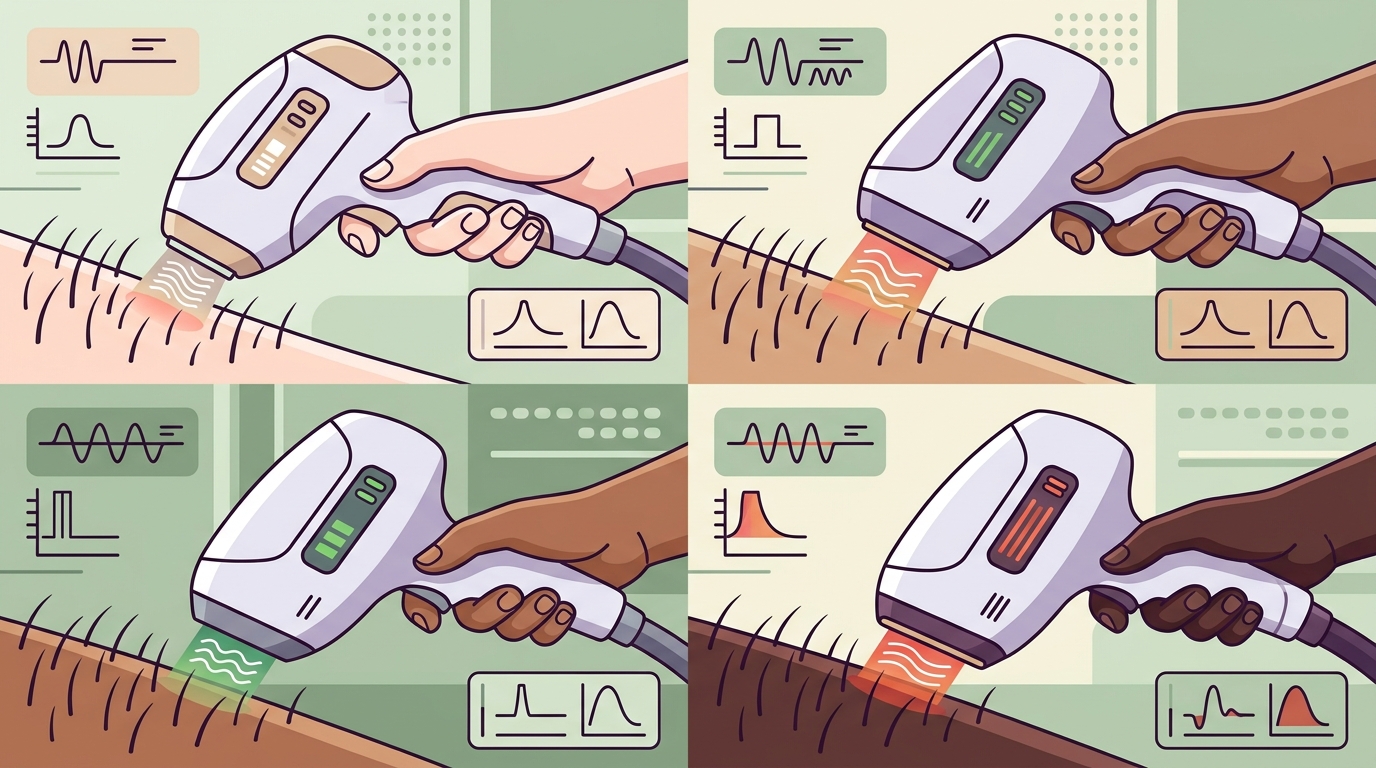
Alexandrite Laser (755 nm)
The Alexandrite laser is best suited for Fitzpatrick types I through III. It offers a shorter wavelength that is highly absorbed by melanin, making it very effective for lighter skin with dark hair. However, this high melanin absorption makes it riskier for darker skin tones.
Diode Laser (808-810 nm)
A diode laser is a semiconductor-based device that emits near-infrared light to penetrate deeper into the skin while offering a balance of safety and efficacy. At Contour Body Aesthetics in Glenwood Springs, we use an 808 Diode Laser that absorbs melanin in the hair follicle and converts it to heat, destroying follicles while preventing future growth. The diode wavelength works well for Fitzpatrick types I through IV.
Nd:YAG Laser (1064 nm)
The Nd:YAG laser is a neodymium-doped yttrium aluminum garnet laser that operates at 1064 nm, offering the deepest penetration and lowest melanin absorption of the three. According to research published in the Journal of Drugs in Dermatology, this wavelength bypasses epidermal melanin and preferentially targets deeper dermal structures like hair follicles, making it the safest choice for Fitzpatrick types IV through VI.
Laser Hair Removal for Light Skin (Types I-III)
Individuals with Fitzpatrick types I through III are generally ideal candidates for most laser types due to the high contrast between their skin and dark hair. The Alexandrite and diode lasers are particularly effective for these skin types, delivering fast results with minimal risk of side effects.
That said, even lighter-skinned clients should avoid sun exposure before and after treatment. At our Glenwood Springs skin care clinic, we recommend wearing high-SPF sunscreen daily during your treatment series to protect treated areas and maintain results.
Laser Hair Removal for Dark Skin (Types IV-VI)
Darker skin contains more melanin, which can compete with hair follicles for laser energy absorption. Using the wrong laser or incorrect settings on darker skin tones increases the risk of burns, hyperpigmentation, or scarring. However, with proper technology and technique, darker-skinned individuals can undergo laser hair removal safely and effectively.
The Nd:YAG laser's longer wavelength ensures that energy reaches the hair follicle without being overly absorbed by the surrounding skin. Longer pulse durations and integrated cooling systems further reduce risk. A personalized consultation is critical for these skin types, so our team creates a customized treatment plan based on your specific needs.
What to Expect During and After Treatment
Regardless of skin type, most patients require four to six sessions spaced about one month apart for optimal results. Hair grows in cycles, and the laser is most effective during the active growth phase, which is why multiple sessions are necessary.
During treatment, most patients feel a sensation similar to a small rubber band snap on the skin. Cooling gels and built-in cooling systems help minimize discomfort. After treatment, mild redness and slight swelling may last a day or two. You should avoid direct UV exposure, apply sunscreen consistently, and skip waxing or plucking between sessions.
To complement your skin health during and after your laser series, consider exploring our customized facial treatments for post-treatment skin rejuvenation.
Key Takeaways
- Laser hair removal targets melanin in the hair follicle using selective photothermolysis.
- The Fitzpatrick scale classifies skin into six types and directly guides laser selection and settings.
- Alexandrite lasers (755 nm) work best for lighter skin types (I-III), while Nd:YAG lasers (1064 nm) are safest for darker tones (IV-VI).
- Diode lasers (808 nm) offer versatility for a broad range of skin types, especially types I through IV.
- Modern laser technology has made safe, effective hair removal accessible across all skin tones.
- Most patients need four to six sessions, spaced one month apart, for lasting results.
- A professional skin-type assessment before treatment is essential for safety and efficacy.
Frequently Asked Questions
What is the Fitzpatrick scale?
The Fitzpatrick scale is a six-point classification system developed in 1975 that categorizes skin based on its reaction to sun exposure. It helps aesthetic professionals select the right laser type and energy settings for each patient.
Can laser hair removal work on dark skin?
Yes. With the right laser, particularly the Nd:YAG at 1064 nm, darker-skinned individuals (Fitzpatrick types IV-VI) can achieve effective hair reduction safely. The key is using a longer wavelength that bypasses epidermal melanin.
Which laser does Contour Body Aesthetics use?
We use an 808 Diode Laser, which emits near-infrared light absorbed by melanin in the hair follicle. This technology is effective for a wide range of skin types and includes a cooling system for patient comfort.
How many sessions will I need?
Most patients see a marked reduction in hair growth within four to six treatments, scheduled about one month apart. Factors such as hair density, hormones, and the treatment area can influence the total number of sessions.
Does laser hair removal hurt?
Most patients describe the sensation as similar to a small rubber band snapping against the skin. We use topical anesthesia and cool gel to minimize any discomfort during treatment.
Is laser hair removal effective on blonde or red hair?
Laser hair removal is least effective on light blonde, red, white, or gray hair because these colors contain very little melanin for the laser to target. A consultation can help determine if you are a good candidate.
What should I avoid before and after treatment?
Avoid waxing, plucking, and electrolysis for six weeks before your session, as these methods remove the hair root the laser needs to target. After treatment, apply sunscreen daily and avoid direct sun exposure on treated areas.
Can I combine laser hair removal with other treatments?
Yes. Many clients pair laser hair removal with other services like body contouring or facials as part of a comprehensive aesthetic plan. Your specialist can advise on timing and sequencing.
Ready to Find the Right Laser for Your Skin Type?
Every skin type deserves a tailored approach. At Contour Body Aesthetics in Glenwood Springs, Colorado, we assess your unique Fitzpatrick type and create a personalized laser hair removal plan designed for safe, lasting results. Book your free consultation today and take the first step toward smooth, confident skin.