

Laser hair removal is one of the most popular aesthetic treatments worldwide, but not every laser works the same way on every skin tone. Understanding how your skin type influences treatment safety and effectiveness is critical before you book a session. At Contour Body Aesthetics in Glenwood Springs, CO, we customize every laser hair removal plan to match each client's unique skin and hair profile. This guide breaks down the science behind laser hair removal, explains the Fitzpatrick skin type scale, and shows you which laser technologies deliver the best results for your complexion.
How Laser Hair Removal Works
Laser hair removal is a cosmetic procedure that uses concentrated light energy to target and disable hair follicles. The process relies on a principle called selective photothermolysis, which means selectively heating a target chromophore while minimizing damage to surrounding tissue.
Melanin is the pigment that gives hair and skin their color. During treatment, the laser emits light that is absorbed by melanin in the hair follicle. That absorbed energy converts to heat, which damages the follicle and inhibits future hair growth. Because hair grows in cycles, multiple sessions are needed to treat follicles during their active growth phase.
The Fitzpatrick Skin Type Scale
The Fitzpatrick scale is a dermatological classification system developed by dermatologist Thomas Fitzpatrick in 1975 that categorizes skin into six types based on its reaction to ultraviolet (UV) exposure. It remains the standard tool practitioners use to determine safe laser settings for each patient.
| Fitzpatrick Type | Skin Tone | Sun Reaction | Best Laser Options |
|---|---|---|---|
| Type I | Very fair | Always burns, never tans | Alexandrite, Diode |
| Type II | Fair | Burns easily, tans minimally | Alexandrite, Diode |
| Type III | Medium | Burns moderately, tans gradually | Alexandrite, Diode |
| Type IV | Olive | Burns minimally, tans easily | Diode, Nd:YAG |
| Type V | Brown | Rarely burns, tans darkly | Nd:YAG |
| Type VI | Dark brown/black | Never burns | Nd:YAG |
Knowing your Fitzpatrick type helps your provider choose the correct wavelength, pulse duration, and energy level to maximize hair reduction while protecting your skin.
Laser Types and Their Ideal Skin Tones
Not all lasers are created equal. Different wavelengths penetrate the skin to different depths, and each interacts with melanin in a unique way.
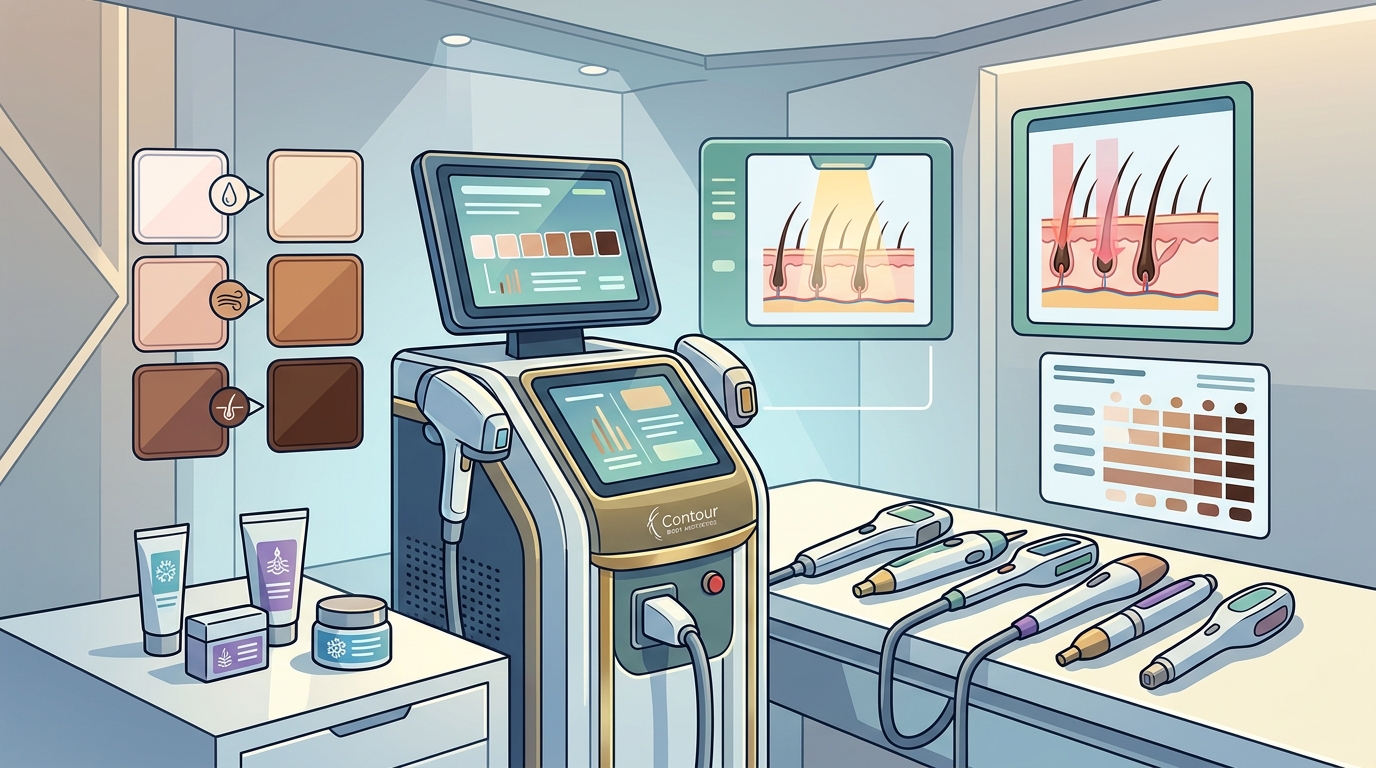
Alexandrite Laser (755 nm)
The Alexandrite laser is a high-speed laser best suited for Fitzpatrick types I through III. Its shorter wavelength is highly absorbed by melanin, making it extremely effective on light skin with dark hair but riskier for darker complexions.
Diode Laser (808-810 nm)
A diode laser is a near-infrared device that offers deeper penetration than the Alexandrite while still targeting melanin efficiently. At Contour Body Aesthetics, we use an advanced 808 Diode Laser that absorbs melanin in the hair follicle, generating heat to destroy follicles and prevent future growth. The diode wavelength works well for skin types I through IV and, with careful settings, can treat some type V patients.
Nd:YAG Laser (1064 nm)
The Nd:YAG laser is a long-wavelength device specifically designed for safe treatment of darker skin. According to research published in the Journal of Drugs in Dermatology, the 1064 nm wavelength penetrates deeper and has lower melanin absorption at the skin surface, allowing energy to reach the hair follicle with minimal risk to epidermal pigment. This makes it the gold standard for Fitzpatrick types IV through VI.
Laser Hair Removal for Light Skin (Types I-III)
Patients with lighter skin and dark hair are considered ideal candidates for laser hair removal. The strong contrast between hair melanin and skin pigment allows the laser to precisely target follicles with minimal risk of surface damage.
Alexandrite and diode lasers are typically the first choice for these skin types. Treatment sessions tend to be faster, and most patients see a significant reduction in hair growth within 4 to 6 sessions. Patients with very light or red hair, however, may see reduced efficacy because there is less melanin for the laser to target.
Laser Hair Removal for Dark Skin (Types IV-VI)
Darker skin contains more melanin in the epidermis, which can compete with follicular melanin for laser absorption. Using the wrong laser or incorrect settings on darker skin increases the risk of burns, hyperpigmentation, or scarring.
Modern Nd:YAG lasers have made laser hair removal accessible and safe for darker skin tones. The longer 1064 nm wavelength bypasses surface melanin and delivers energy directly to the hair follicle. With proper settings and an experienced provider, patients with Fitzpatrick types IV through VI can achieve effective, lasting hair reduction.
At Contour Body Aesthetics, every treatment begins with a thorough skin assessment so we can tailor settings precisely to your complexion and hair characteristics.
What to Expect During Treatment
Your first visit will include a consultation where your provider evaluates your skin type, hair color, and treatment goals. Before the procedure, avoid waxing, plucking, or electrolysis for six weeks, as the laser needs intact hair roots to be effective. Shaving before your appointment is fine.
During the session, you will wear protective eyewear. Most patients describe the sensation as a warm sting, similar to a small rubber band snap. A built-in cooling system helps minimize discomfort. Small areas like the upper lip take under a minute, while larger areas like the legs may take up to an hour.
After treatment, mild redness and swelling may occur but typically subside within a day or two. Protect treated areas with broad-spectrum sunscreen and avoid intense UV exposure while the skin heals. Explore our full range of body treatments to complement your results.
Key Takeaways
- Laser hair removal works by targeting melanin in hair follicles through selective photothermolysis.
- The Fitzpatrick scale classifies skin into six types based on UV response and is essential for safe laser treatment.
- Alexandrite lasers (755 nm) work best for fair skin types I-III; diode lasers (808 nm) cover types I-IV; Nd:YAG lasers (1064 nm) are safest for types IV-VI.
- Darker skin requires longer wavelengths to bypass epidermal melanin and reduce side-effect risks.
- Most patients need 4 to 6 sessions, spaced about a month apart, for optimal results.
- Always consult a qualified provider who assesses your skin type before selecting laser settings.
- Post-treatment sun protection is critical regardless of skin tone.
Frequently Asked Questions
Is laser hair removal safe for dark skin?
Yes. With the right laser technology, specifically the Nd:YAG at 1064 nm, laser hair removal is both safe and effective for Fitzpatrick skin types IV through VI. The key is working with an experienced provider who tailors settings to your skin.
What is the Fitzpatrick scale?
The Fitzpatrick scale is a six-point classification system developed in 1975 that categorizes skin based on how it reacts to sun exposure. It guides practitioners in choosing safe and effective laser parameters.
Which laser does Contour Body Aesthetics use?
Contour Body Aesthetics uses an advanced 808 Diode Laser. This near-infrared device targets melanin in the hair follicle while a cooling system keeps the skin comfortable during treatment.
Can laser hair removal treat light or blonde hair?
Laser hair removal is least effective on very light blonde, red, or gray hair because these colors contain minimal melanin for the laser to target. A consultation can help determine if you are a good candidate.
How many sessions will I need?
Most patients see significant hair reduction in 4 to 6 sessions, spaced approximately one month apart. Factors like hair density, hormones, and treatment area can influence the total number of visits.
Does laser hair removal hurt?
Most patients compare the sensation to a small rubber band snap. Cooling systems and topical numbing agents help minimize any discomfort during the procedure.
What should I avoid before my appointment?
Avoid waxing, plucking, and electrolysis for at least six weeks before treatment. Shaving is fine because it leaves the hair root intact. Also avoid excessive sun exposure and tanning beds.
How do I care for my skin after treatment?
Apply broad-spectrum sunscreen daily and avoid intense UV exposure. Some redness is normal and usually resolves within a couple of days. Your provider may recommend soothing products to aid recovery.
Ready to Get Started? Book Your Consultation Today
Every skin type deserves a personalized approach. At Contour Body Aesthetics in Glenwood Springs, we evaluate your unique skin and hair profile to design a laser hair removal plan that is safe, effective, and tailored to you. Book your free consultation today and take the first step toward smooth, lasting results.